Japanese job internship program: student - internship job japanese

Application procedures and deadlines Scholarships by JASSO

1 Honors Scholarship for Privately Financed International Students
(1) Qualifications and Description
The qualifications for applicants and financial aid are shown as follows.
The qualifications do not include the age limit, designated Japanese schools to attend nor designated courses to major in in Japan.
Honors Scholarship for Privately Financed International Students

(2) How to apply
Applications for the Honors Scholarship for Privately Financed International Students
will be accepted through universities (including graduate schools), junior colleges,
professional training colleges(advanced course), colleges of technology, university
preparatory course (designated by MEXT) or Japanese language institutes which
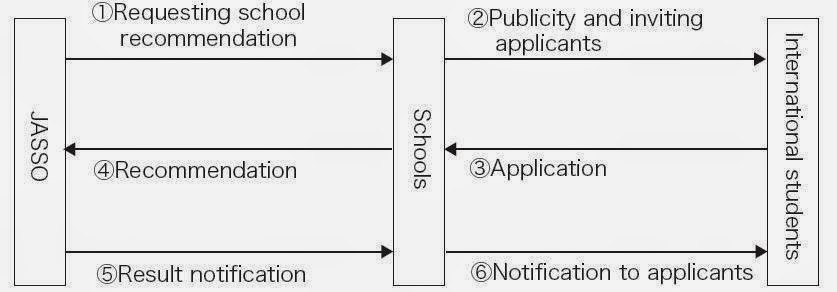
applicants attend in Japan (hereinafter referred to as “schools”)( ① , ② ). The applicants
must fill in an application form (available at the school office in charge), submit it to
their schools( ③ ) to have them recommend to JASSO that they are qualified to receive
an Honors Scholarship( ④ ). The applicants must contact the schools to confirm the

application procedure.

Information on the reservation program based on scores of Examination for Japanese
University Admission for International Students (EJU exam in Japan and EJU Overseas
Exam) is available at JASSO’s website

( http://www.jasso.go.jp/scholarship/yoyakuseido.html)

(3) Notification of result
After its screening process(⑤) , JASSO will notify students through the school of the result.
( ⑥ )

The process from filling an application through to result notification is shown as follows.


2 JASSO Student Exchange Support Program ( Scholarships for Short-term Study in Japan)
JASSO offers scholarships for international students who are accepted by a Japanese university, junior college, college of technology (hereinafter refered to as "school") under a student

exchange agreement between Japanese host university and their home higher educational institution abroad.

a. Qualifications and contents of scholarship
Qualifications and contents of scholarship jasso


b. Application procedures and deadlines
Japanese schools submit their yearly student exchange plans to JASSO by December 22,
2010. According to the yearly plan, JASSO will allocate the quota of scholarships to each
Japanese school. Within this quota, Japanese schools will recommend their exchange
students to JASSO by each of the three deadlines. JASSO will make a final decision after a
screening of all documents submitted by the Japanese schools.
Application deadlines for students will differ by each Japanese school, and the applicants
must contact the Japanese school to confirm the application schedule and the necessary
documents.
The recommendation deadlines for Japanese schools are as follows:
a. March 4, 2011: for the students starting their studies between April and July.
b. May 20, 2011: for the students starting their studies between August and November.
c. September 22, 2011: for the students starting their studies between December and
March.
c. Time of arrival in Japan
Students must arrive at the Japanese host school within the period designated by the

Japanese host school (from April 1, 2011 to March 15, 2012)
Application procedures and deadlines jasso


Japanese Government (Monbukagakusho: MEXT) Scholarships

Japanese Government (Monbukagakusho: MEXT) Scholarships

(1) Types and their conditions : There are seven types in Japanese Government Scholarships.
Japanese Government (Monbukagakusho: MEXT) Scholarships

(2) Application Procedure

① Embassy Recommendation (Application through Japanese embassies)
Recruiting covers all scholarship categories. However, because recruiting targets will
differ by country and region, potential applicants should check closely with the Japanese
embassy in their own specific country or region.

The initial screening is comprised of a document inspection, a written test and an
interview. Subjects of the written test vary somewhat by country and region, but generally
consist of the following.

Application Procedure

The local Japanese embassies conduct their screening on the basis of these test results,
and then make their recommendations to MEXT. MEXT confers with the selection
committee, deliberates with the host schools, and then makes its final selections. While
candidates may express their preferences for specific shools of study, the final decision
will be made by MEXT.

For further details, candidates should contact the Japanese embassy in their own specific
country or region.

② Application through Japanese Universities

-1 University Recommendation (selection of new applicants before they
arrive in Japan)
Based on the university exchange agreement, Japanese universities conduct their
examinations of the international student candidates, with recommendations made
to MEXT as research students or Japanese studies students. MEXT confers with the selection committee, and then makes its selections. For further details, candidates should
contact their current school of enrollment.
-2 Domestic Selection (selection of privately financed students already in
Japan)
Targeted under this category are privately financed students currently studying at
Japanese universities. Qualified are third-year undergraduates expected to advance to
fourth-year regular student status (sixth-year status in the case of medical, dental or
veterinary students or those majoring in 6-year system pharmaceutical sciences), fourthyear
students expected to advance to regular Master's program student status, or Master's
or Doctoral students expected to remain as regular students for one year or longer.
Applicants with excellent academic records are chosen to attend from the new school year
as undergraduate or research students.
For further details, candidates should contact their current school of enrollment.

Applicants must pass this first stage and then a second stage of screening by MEXT
(document screening) before a final decision is made.
The general flow of an application is as follows.
Application through Japanese Universities

For Young Leaders Program, the recruitment will be conducted through the embassies
of Japan in target countries upon the recommendation of recommending authorities. Initial
selection will be made through document screening, interviewing, essay writing, etc..
The second selection will be done by YLP Committee set in MEXT, and hence the final
decision on candidates.

(3) Recruiting, Arrival in Japan

The recruiting period will differ by country and region, although the following timing
normally applies.
Recruiting, Arrival in Japan

Japanese internship program registration information
Japanese internship program

A Guide to Japan Scholarships

 Japanese Government (Monbukagakusho:MEXT) Scholarships

 The Ministry of Education, Culture, Sports, Science and Technology (Monbukagakusho:MEXT)
of the Japanese Government has been inviting international students to study in Japan at
state expense since 1954. Applications should be made through Japanese embassies or
consulate-generals abroad or Japanese universities.

Japanese universities

Undergraduate Students

Ⅱ Scholarships by JASSO

"Honors Scholarship for Privately Financed International Students" has been provided
by JASSO. Applications should be made through Japanese universities.
Honors Scholarship by JASSO

JASSO offers Student Exchange Support Program (Scholarship for Short-term Study in
Japan) for those accepted by Japanese universities under student exchange agreements
with their home universities.

Undergraduate student at a university abroad

Ⅲ Scholarships by local governments and local international associations

Local governments in Japan provide scholarships to people living in their district or to
students who attend schools in their district.

Local governments in Japan provide scholarships

Ⅳ Scholarships by private foundations

Private foundation scholarships are provided by private companies or organizations.
Reflecting the objective and character of the company or organization, scholarships are
likely to be granted to students attending schools in a given district, or limited to special
subjects related to the company, or to be provided to students from a certain country or
region with which the enterprise has exchanges.

Private foundation scholarships are provided by private companies or organizations

Ⅴ Scholarships available abroad

Although most of the scholarships are available after coming to Japan, several local
governments, international associations and private foundations accept applications from
overseas.
scholarships are available after coming to Japan


For those of you who want to work in Japan, you can follow the selection of non imm apprenticeship through directly by the recipient company in japan / organization Accepting registration can be done online »


Procedure Entry and Living in Japan

Living in Japan
Disclaimer: granting permission to enter or commonly called visa and permission to stay in Japan is a right and full authority Japanese government. If a person is denied a visa or residence permit, the Japanese government is not required to notify the reasons for the refusal to the person concerned. Embassy in Tokyo can not give a recommendation for someone in order to obtain permission to enter or permission to stay in Japan. The answers below are not the official stance of the Indonesian Embassy in Tokyo, but the usual recommendation is given to answer the most frequently asked questions.

I want to visit in Japan, what should I do?

If someone from a country want to visit another country, then the question must obtain permission to enter or commonly called a visa to the country to be visited. The same goes for someone who wants to visit Japan. You are required to obtain an entry visa to Japan is engraved or affixed to your passport. Please contact the Consulate of Japan in Indonesia (Consulate in Jakarta, Surabaya, Medan, Makassar and Denpasar) to obtain an entry visa to Japan's information and please contact your local immigration office to obtain complete information about passport issuance RI.

Once you obtain an entry visa to Japan, please check your visa category column. Customize categories with the aim of you go to Japan, for example, the category 'as a temporary visitor' is only intended for those who are visiting for a short visit tourist destinations or other unauthorized earn, the category 'as trainees' aimed at those who visit for the purpose of apprenticeship and others. You must not engage in activities outside the permitted categories, such as you engage in activities that generate the wage (working) while you hold a visa 'as a temporary visitor'. Violation of the ban will be subject to criminal sanctions and a ban for a minimum of 10 years by the Japanese government.

I want to work in Japan, what should I do?

In contrast to other countries - such as Malaysia, South Korea or the Gulf States - The Japanese government is very selective in accepting foreign workers. That legally, the informal sector is closed to foreign workers, however, foreign nationals working as a professional (engineer, manager) it is possible to enter and work in Japan.

However, to anticipate national regulations, some channeling institutions in Japan opens opportunities for interns (kenshuusei) to conduct technical training in Japan and help industries semi-skilled labor shortages. Therefore, semi-skilled workers in Japan is not the person's status as a labor force, but existed as interns. To be remembered, that the chance of apprenticeship in Japan is only valid for three (3) years and a lifetime. For those of you who have had the opportunity apprenticeship in Japan, you are prohibited from an apprenticeship program again, and based on existing experience, for those who violate this prohibition shall be sanctioned and barred from entering Japan within a minimum period of 10 years by the Japanese government.
For those of you who have professional skills (engineers, managers, and others), you can gain employment in Japan through the Japanese company hiring a professional job. The opportunity to work in Japan for the other professionals can also be obtained by studying at Japanese universities. As an illustration, many Indonesian professionals who are in companies in Japan were recruited from Japanese universities where they studied.
For those of you who do not have professional skills, please contact your local labor department and ask for an internship opportunity in Japan. Institutions such as the IMM dealer apprenticeship working with the labor offices in several regions in Indonesia to recruit interns from Indonesia. In addition, many agencies trainee dealer operating in Indonesia.
Information about the apprenticeship program to Japan are on the website of Directorate of Apprenticeship Manpower RI while sending information about Nurse and Caregiver program to Japan are on the site BNP2TKI


I have visas to come to Japan and arrived in Japan, what should I do?

If you are visiting Japan for any purpose, we advise you to always make contact and report themselves to the Indonesian Representative in Japan, Embassy in Tokyo and Consulate General in Osaka (for those who live in the prefecture-prefecture following: Fukui, Hyogo, Mie, Osaka, Kyoto , Nara, Shiga, Wakayama, Hiroshima, Okayama, Shimane, Tottori, Yamaguchi, Ehime, Kagawa, Kochi and Tokushima).
For those of you who have permission to enter and stay less than 90 days, you are not required to obtain a registration of foreign nationals, but for those who have a residence permit for more than 90 days, in accordance with the provisions of the Government of Japan, you are required to register foreign nationals . Please contact the Office of the Immigration Bureau or the Office of Government on where you live to obtain complete information on the registration of foreign nationals.


I have gained a short-stay visa to Japan, if I could extend the visa?

Extension of permission to enter or change of residence permit for foreign nationals residing in Japan are the rights and authority of the Japanese government in this case Immigration Bureau, the Ministry of Justice of Japan. For the possibility of an extension or change of such permission, please contact the immigration bureau office where you live now. But briefly be stated that the Immigration Bureau of Japan will grant an extension or amendment of the permit based on the circumstances and the conditions that have to meet.


I entered on a tourist visa, but I have lived in Japan overstayed my visa, what should I do?

That legally, you have violated the Act Immigration Control and Refugee Japan. These violations result in criminal sanctions, deportation and a ban by the government of Japan. If you already overstayed a visa, it is recommended that you contact the Office of the Immigration Bureau at the moment where you live and ask for help solving.
However, the Japanese government in this case Immigration Bureau, the Ministry of Justice of Japan will give your residence permit to have violated the time limit to stay if you are deemed to meet the requirements set by the government of Japan. One of the requirements is that you have a family (husband or wife or child or parent) who has a valid residence permit in Japan or Japanese national.


I went to Japan with a student visa, can I work in Japan?

In principle, you are only allowed to conduct activities in accordance with a permit granted. However, if you go in with a student visa, you are allowed to work part-time in Japan. The main requirements of your work permit is a permit to work part-time from the educational institution where you study. Please consult your desire to work part-time with the leadership of the institution where you study and with the local office of the Bureau of Immigration.
The same thing also applies to those who have permission to stay in Japan in addition to residency 'as a temporary visitor'. However, to obtain a work permit, we recommend that you always consult with your local office of the Bureau of Immigration to prevent the violation of a residence permit.

Similarly, information about the Entry and Stay Permit in Japan may be useful

How to Work Part Time in Japan

How to Work Part Time in Japan
According to research conducted by JASSO , approximately 76 % of students with the status of residence as a " College Student " part-time work . This type of work is the work diindustri most food . In addition, many who work in in sales, teaching language , research assistant , receptionist or hall . Hourly wages sometimes different depending on the area and type of work . As a reference , working in the food industry , wages 800 Yen- 1,200 Yen. So when working within the limits of the prescribed period of 28 hours , then the income earned into 22,400- 33,600 yen / week .

Students who wish to work part-time must obtain permission from the local immigration bureau for activities outside the resident status is granted . The requirements for activities outside the status that has been given is as follows .

1 Do not interfere with the primary task as a student
2 Aiming seek additional funds for tuition on the like for studying in Japan
3 not to work are included in the regulation and supervision of the entertainment business ethics violate public order .
4 Number of hours worked is no more than 28 hours / week ( maks.8 hours / day on a long holiday )
5 Do for still a student at the Institute of Education

Effective as of July 9, 2012 , when the exchange Resident Card when landing at the airport , Working Permit registration can also be done ( currently only at Narita Airport , Haneda , Chubu and Kansai ) .
Information can be obtained part-time employment welfare section University , or the National Public Employment Agency as " Hello Work " etc.

※ When the work without permission or work beyond the deadline or the type of work that have been defined then it is likely be deported to the country of origin .
Type of Work for Part Time Work
(based on multiple answers )
List Work Part Time in Japan
message from
seniors :
Working part-time is working in Japanese companies . So that could be a valuable lesson to learn manners and customs to work in Japanese companies . But there are also cases of foreign students are overworked part-time so could not concentrate on learning and school attendance rate is low . As a result, students are forced to return to their home country because he could not extend his residence permit . It must be remembered that the purpose of our being in Japan is to learn not to work


part time work


Similarly, Article about Info Part Time Work in Japan may be useful
 
Copyright © 2014. Japanese job internship program - All Rights Reserved | Template - Dagangku.com
Proudly powered by Blogger